


Turbidity Caused by Dredging; Viewed in Perspective
The environmental impact of turbidity depends upon the dredging technique used; the ease with which the sea bed material becomes resuspended; and the condition of the surface water. An on-site analysis is advisable.
Uncertainty Analysis of the Mud Infill Prediction of the Oklng Approach Channel
To take well-founded financial decisions, help manage risks and reduce uncertainty, a model for calculating the probabilistic assessment of maintenance dredging volumes was developed using the Olokola LNG project near Lagos, Nigeria, as an example.
Underwater Sound in Relation to Dredging (CEDA Position Paper)
The sea is full of fish and aquatic mammals “talking” to each other. Do the sounds of dredging disturb this communication?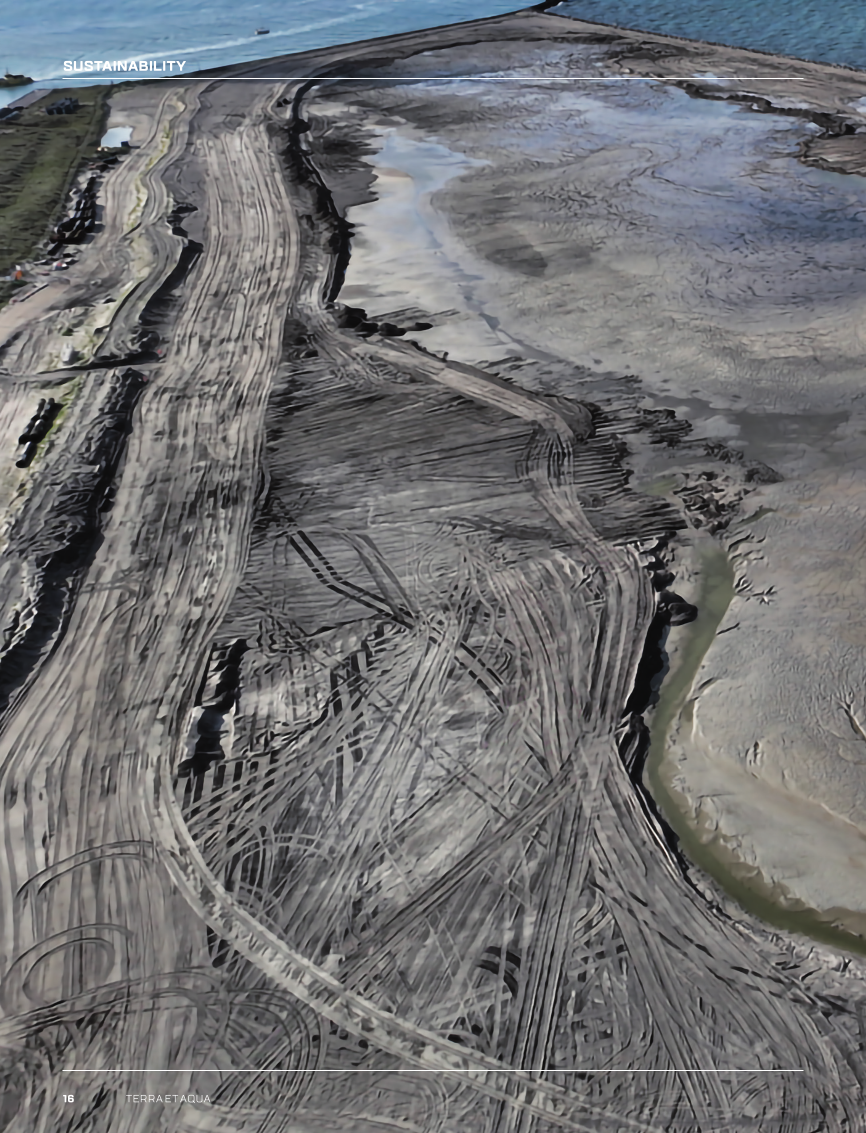
Unsuitable to suitable: a change in the reclamation design paradigm
The availability of suitable sand has become a limiting factor in the development of many ambitious reclamation projects, making the reuse of existing, less suitable materials a critical solution. This subject has been given broader international attention in the past years driven by the shortage of sand resources and by the desire for a more circular society where waste does not exist. So far, only a few examples exist of islands that have been constructed with fine silty or even clayey sediment. In this context, the reclamation with sediments must evolve from an exceptional case requiring special considerations, to a common practice. To favour this practice, an integrated framework is needed where the concepts of suitable and unsuitable are redefined.
Upscaling seagrass restoration with insights from seed-sediment dynamics
Seagrass restoration is increasingly recognised for its potential to enhance biodiversity and contribute to carbon sequestration. However, planting methods are largely based on manual techniques, posing challenges for upscaling and implementation as nature-based solutions (NbS) within the dredging industry. To address this, techniques to combine sediment nourishments with seed-based seagrass restoration are explored. Seed settlement behaviour is investigated via laboratory experiments, analysing seed settling velocities and distribution in various sediment concentrations, revealing the importance of grain size and sediment dynamics. These findings lay the groundwork for innovative, large-scale restoration techniques leveraging traditional dredging methods, with pilot projects planned for 2025.
Using Subsurface 3D Modelling for Planning Waterfront Construction in Archaeologically Sensitive Areas
By showing existing historic conditions with utmost clarity, comprehensible to all stakeholders and parties, subsurface 3D modelling leads to the collaborative communication necessary for beneficial project planning.
Utilising the Full Potential of Dredging Works: Ecologically Enriched Extraction Sites
Rather than focus on minimising negative effects, ecologically designed sand mining can maximise positive opportunities to dredge and create new habitats.